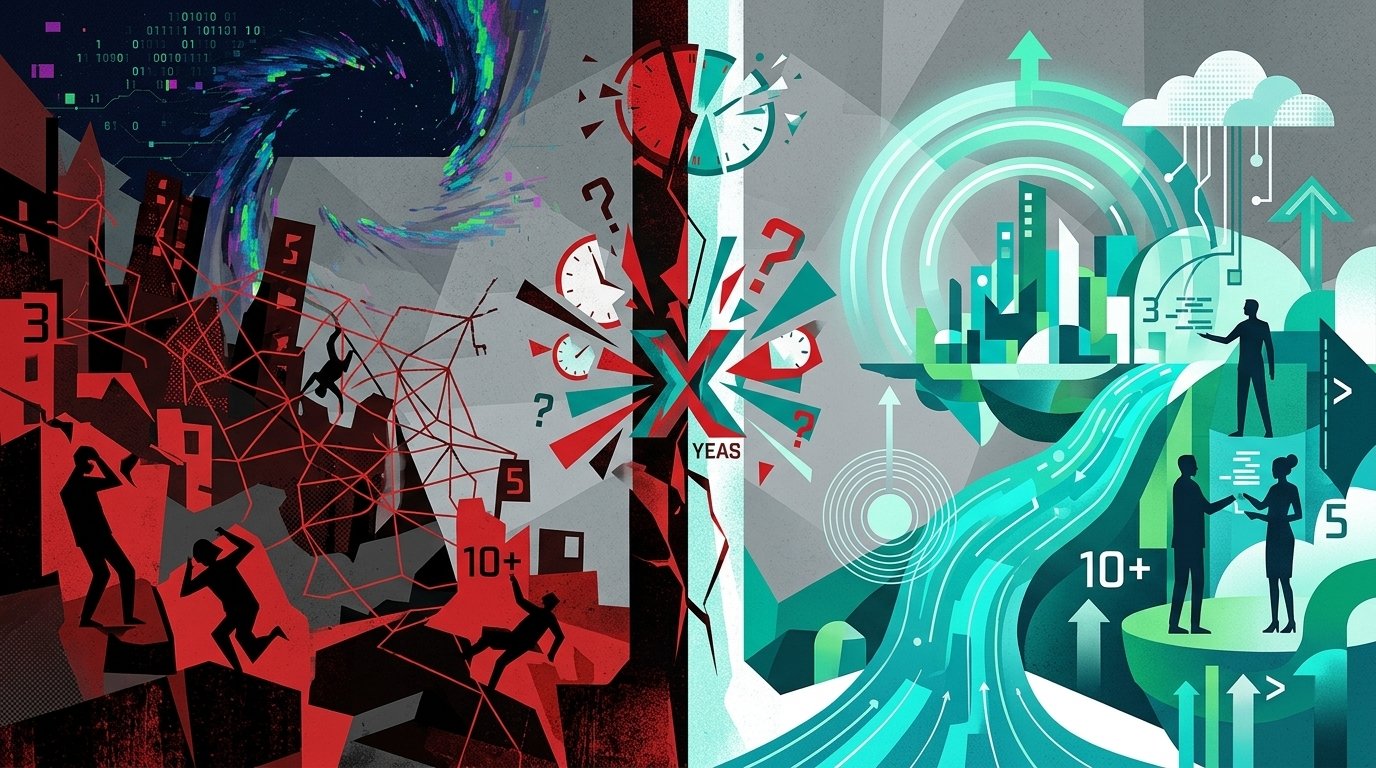
I’m neither an AI-doomer nor an AI-evangelist. I think the technology will continue to evolve and create huge change in most fields, but I’m not at all in the boat of “mass-unemployment in 2 years, super intelligence in 5”. On the other hand, I don’t think the people saying that AI has already peaked, it’s all a bubble, and nothing particularly dramatic will happen are necessarily right either.
I think where a lot of this breaks down is that it’s just impossible to predict things far into the future. And when I see researchers, though especially the Doomers or Fearmongers, but to some equal extent also the “ASI is right around the corner” crowd, talk about the speed at which AI will progress, it grinds my bones quite a lot. When they position themselves as an authority and tell an audience of millions of people on a podcast that “it’s extremely likely (or guaranteed) that XYZ outcome will happen in 3 years, this in 5 years, and thus this in 10 years”.
We don’t know that. They don’t know that. No one knows, and dare I say, it’s impossible for anyone to know.
This blog post will feature a lot of thumbnails from YouTube, and links to those videos. I am not affiliated with those channels, and do not endorse, support, or have a particular attitude to any of them in particular – they are used as examples of the predictions I will be discussing.

Maybe AI gets a new breakthrough in the same way the Google paper on Transformers eventually evolved into current-day AI systems, and research speeds up in ways we cannot imagine. Maybe we hit unforeseen roadblocks in the technology that we can’t imagine yet. Maybe both happen, one after another.
That’s the problem with predicting AI. We aren’t just trying to predict how quickly a particular benchmark will improve. We’re trying to predict what technologies will be invented, which problems will be solved, which new problems those solutions will create, what they’ll cost, whether companies can make money from them, how governments will react, how the public will react, whether the infrastructure can support them, and how all those things then influence the next set of developments.
And that’s before getting to all the things we don’t even know are relevant yet.
Humans have always been terrible at predicting the future
Wanting to predict the future is nothing new, and plenty of people have tried probably ever since our brains evolved to understand the concept of “tomorrow”. Kings have hired sages, wizards and mystical old women from the bogs. Investment firms hire the best and the brightest to create advanced algorithms that grind through enormous amounts of data day and night. Politicians hire analyst firms to predict how people will vote in the next election. Generals have entire sections dedicated to trying to predict how a war will unfold.
People have been trying to predict the weather so we can prepare for harsh seasons. We have tried to predict political movements so we can prepare for war. We try to predict whether our neighbours are going to get divorced, whether the housing market will crash, or which sports team will win the next match.

Some of those things we have gotten much better at. Weather prediction is an obvious example. But even there, we have a wealth of satellites and ocean buoys capturing cloud patterns, atmospheric pressure, temperature changes in the ocean and countless other measurements, sharing that data globally among tens of thousands of researchers, feeding it through extremely sophisticated computer models – and whether the forecast for your particular location tomorrow actually turns out correct can still be hit or miss.
That’s for tomorrow.
So when somebody tells me with great confidence what AI will do to civilization in 20 years, I’m just a little bit skeptical.
Nostradamus is perhaps the funniest historical version of this. He predicted a great many things, but he also predicted a great many things that never came to pass. People look through what he wrote, find something sufficiently vague, twist it around until it resembles a modern event, ignore all the statements that never came to pass in any recognizable sense, and conclude: “Look! He predicted the future!”
Absolute rubbish.
There’s a huge survivorship bias in predictions. We remember the people who happened to get something right, precisely because they got it right. We don’t talk nearly as much about the usually far greater number of people who made equally confident predictions that turned out to be completely wrong.
If we could predict two years ahead, every stock trader would be a billionaire
I think we can give solid guesstimates in maybe the 2-3 year range. Five years starts becoming pretty improbable. Ten years becomes guesswork. Twenty years becomes pure fiction.
But even 2-3 years isn’t really serious if by “prediction” we mean something close to certainty – and the stock market proves that quite nicely. If it was possible, even broadly across sectors, to predict the future 2-3 years ahead with strong certainty, every stock trader would be a billionaire. Investors would never lose fortunes in crashes. Investment firms wouldn’t pay enormous salaries to armies of analysts who then still regularly turn out to be wrong.

Of course, that doesn’t mean probabilistic inference is useless. I believe in it, and use it quite a bit myself, especially in regards to investing. It’s just very important to be clear that it’s an educated guess, not a guarantee.
You might say: “An insider knows that their company is about to report massively improved earnings, so surely they can predict the stock price will go up.” But in the meantime, a journalist might uncover a scandal nobody at the company even knew was about to become public, resulting in massive public backlash and government intervention, and the stock price plummets.
The original prediction was perfectly logical based on the information available. It would still be wrong.
And sometimes events completely outside the thing you’re trying to predict change everything. You can spend months constructing what you think is the perfect investment portfolio, and then an election changes trade policy. A war begins. A shipping route closes. A pandemic happens. Some company on the other side of the world releases a technology nobody expected.
The problem wasn’t necessarily your reasoning. The problem was that you were reasoning with information that did not include events that hadn’t happened yet.
If we could actually predict the future reliably, every politician would win every election. If Western Europe could have predicted Russia’s full-scale invasion of Ukraine far enough in advance, rearmament would have started a decade earlier. And if Putin could have predicted a war lasting for years, enormous Russian losses and an advance proceeding at a horrifically slow pace, he probably wouldn’t have invaded in the first place.
But he couldn’t. Neither could everyone else.
Unknown unknowns create more unknown unknowns
Twenty years ago, YouTube had existed for just over a year. The biggest resolution you could upload was 480p. You couldn’t upload particularly long videos. Monetization as we know it today didn’t exist. There were no in-video ads.
At that time, it was in a very literal sense impossible to know that 20 years later we would be discussing “brainrot” from young people watching too many TikTok and YouTube Shorts, recommendation algorithms feeding political extremism, or influencers deliberately spreading fake news because ragebait generates engagement.

You could perhaps vaguely have imagined that people would become “self-hosted TV hosts online”, and through that, that some of those people would eventually need management companies or video editors. But those were easy, relatively speaking, to imagine because they were extensions of occupations that already existed.
They were only a single unknown, to some extent.
But so much more happened that relied on unknown unknowns happening. Only once the first unknown turned out to be true (along with the many that didn’t), could you start thinking about the next unknowns. And only once those came true would you become aware of the potential next unknowns that depended on them.
And even then, you wouldn’t be able to predict the solutions to any of those unknowns.
That’s basically what predicting 20, 30 or 50 years into the future is. We can only guess at what the current next unknown might become. We have no realistic idea what that unknown will spawn of later related unknowns that rely on the first unknown happening.
The further out you go, the more prediction just becomes fantasy.
I got my own AI prediction wrong
Around four years ago, when GPT-3.5 came out, I predicted that within a handful of years customer service and junior positions would largely be wiped out. Let’s just stick to the customer service bit.
My thinking was basically: AI will eventually have all the information about a company, and thus it can handle essentially all the normal customer service questions. Makes sense.
But hidden inside that prediction were a bunch of assumptions I hadn’t really thought of as assumptions.

I assumed context windows would quickly become essentially infinite, because realistically you would need hundreds of millions of tokens if the model was supposed to have “all information” about a large company available at once. I assumed hallucinations would quickly become close to zero. I had not in the vaguest sense thought about how prompt injection could be used to steer models towards unfavourable outcomes. I had not at all foreseen that there would be strong anti-AI sentiment among large parts of the population.
And then there were all the other integration problems, costs, existing systems and practical limitations that become obvious once companies actually start trying to implement this stuff.
So what seemed like a reasonable prediction initially was based on incorrectly assuming difficult technical problems would be easy, being unable to foresee entirely new technical problems arising, and not being able to imagine a social backlash because the conditions that would create that backlash hadn’t arrived yet.
That was me, trying to predict just a few years into the future. What exactly am I supposed to do to reliably extend that reasoning out to 2035? And why should I believe anyone that says that they can?
There are already massive variables I don’t think many AI predictions account for. Can electricity grids actually handle the amount of new data-center capacity people are assuming will be built? What happens if the current level of AI investment turns out to be an economic bubble, it bursts, and suddenly enormously expensive research programs lose funding? What happens if regulation radically changes? What happens if public opinion changes? What happens if some completely different technology appears and capital starts flowing into that instead?
And importantly, what happens because of the answers to those questions?

This is what makes long-term prediction so hopeless. Predicting the future isn’t a singular problem where you just need to get enough information and calculate the answer. It’s a complex, “wicked” problem because predicting one outcome relies on information we don’t have about other outcomes we also can’t predict. And the act of making a prediction can itself change what happens, because people and institutions react to the prediction.
We just. don’t. know.
The Doomers and Evangelists are making the same mistake
This is why I’m always suspicious of people who are 100% certain about anything AI-related these days.
The AI Doomer says current progress continues, AGI arrives, then ASI arrives, then something goes horribly wrong.
The AI Evangelist says current progress continues, AGI arrives, then ASI arrives, and we get enormous productivity, abundance, cures for diseases, robots doing all the work and whatever else.
They’re presented as completely opposite positions.
But they’re often built on the same basic assumption: that you can take what is happening today and extrapolate a relatively clean line through a gigantic series of technological, economic, political and social unknowns.
One thinks the end of that line is wonderful. The other thinks it’s terrifying. I don’t think either of them knows where the line goes.
That doesn’t mean AGI or ASI won’t happen. It doesn’t mean mass unemployment can’t happen. It doesn’t mean today’s AI technology won’t run into fundamental limitations either. Any of those things might happen.
I’m saying we can’t know with anything approaching the certainty people routinely pretend to have.

And I’m not saying predictions are useless. It can absolutely be useful to say “if we arrive on this branch, we should have a backup ready”, or “we should do our best to steer away from this branch, because from our current viewpoint it looks likely to result in a bad outcome”. That’s sensible planning.
But that’s very different from saying the branch will happen. Probabilistic inference is useful. Educated guesses are useful. Looking at current trends is useful.
They’re still guesses.
Maybe AI progress accelerates beyond anything we currently imagine. Maybe we discover unforeseen roadblocks. Maybe the next major breakthrough comes from an approach barely anyone is paying attention to today. Maybe some economic, political or social development changes the entire direction of the industry.
“I guess we’ll see.” – That’s pretty much the only AI prediction I’m willing to make with confidence.
Leave a comment